The second volume of our little magazine is available from
https://drive.google.com/file/d/1egs5th7wL2lRm3tqP8e4nfXKk_8IlprJ/view?usp=sharing
The second volume of our little magazine is available from
https://drive.google.com/file/d/1egs5th7wL2lRm3tqP8e4nfXKk_8IlprJ/view?usp=sharing

My son made a new bird feeder from recyclable materials and the sparrows and cardinals are now regular visitors. We don't know for how long though -- the ground is already frozen and the birds may have to fly South.


In the essay, "In what language does rain fall over tormented cities?" in her newly published book, Azadi, Arundhuti Ray notes:
"At a book reading in Kolkata, about a week after my first novel, The God of Small Things was published, a member of the audience stood up and asked, in a tone that was distinctly hostile: "Has any writer ever written a master piece in an alien language? In a language other than his mother tongue?"
I hadn't claimed to have written a masterpiece (nor to be a "he"), but nevertheless I understood his anger towards me, a writer who lived in India, wrote in English, and who had attracted an absurd amount of attention. My answer to his question made him even angrier. "Nabakov", I said. And he stormed out of the hall.
The correct answer to the question today would, of course be "algorithms". Artificial Intelligence we are told, can write master pieces in any language and translate them to masterpieces in other languages. As the era that we know, and think we vaguely understand, comes to a close, perhaps we, even the most privileged amongst us, are just a group of redundant humans gathered here with an arcane interest in language generated by fellow redundants. "
Speaking at the SUNY virtual conference, "Business Disciplines Leaning into the Future: Tips, Tools and Practices for Incorporating Diversity, Equity and Inclusion into Business School Classes"
My talk is entitled "Using African American Literature To Teach Analytics Courses in Business Schools" and part of a session on "DEI in Economics and Quantitative Classes" moderated by SUNY Oswego.
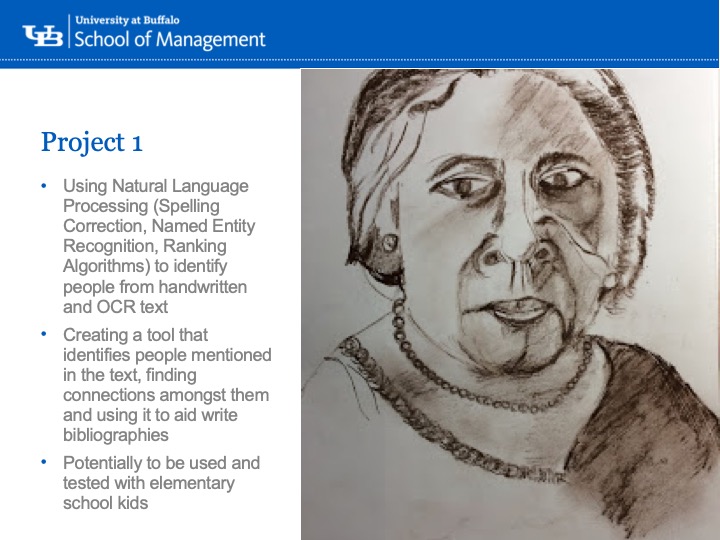
Abstract: This talk focuses on the use of Afro American Literature archives (such as Mary Church Terrell papers from the Library of Congress, records pertaining to American Slave Trade in National Archives and Digital Collections at the University of Buffalo Libraries) in analytics courses. Specifically, we will discuss how large scale text generated by Optical Character Recognition (OCR), which is often garbled, can be stored in large repositories for parallel processing and meaningful information can be extracted from them using natural language processing techniques.
Here are some excerpts from the talk