Showing posts with label Literature. Show all posts

Saturday, July 24, 2021

Arundhuti Ray's take on artificial intelligence, as described in "In what language does rain fall over tormented cities?"

 In the essay, "In what language does rain fall over tormented cities?" in her newly published book, Azadi, Arundhuti Ray notes: 

"At a book reading in Kolkata, about a week after my first novel, The God of Small Things was published, a member of the audience stood up and asked, in a tone that was distinctly hostile: "Has any writer ever written a master piece in an alien language? In a language other than his mother tongue?"

I hadn't claimed to have written a masterpiece (nor to be a "he"), but nevertheless I understood his anger towards me, a writer who lived in India, wrote in English, and who had attracted an absurd amount of attention. My answer to his question made him even angrier. "Nabakov", I said.  And he stormed out of the hall. 

The correct answer to the question today would, of course be "algorithms". Artificial Intelligence we are told, can write master pieces in any language and translate them to masterpieces in other languages. As the era that we know, and think we vaguely understand, comes to a close, perhaps we, even the most privileged amongst us, are just a group of redundant humans gathered here with an arcane interest in language generated by fellow redundants. "


Wednesday, January 27, 2021

Mary Morris Burnett Talbert: A Beacon of Hope

 An educator, suffragist and reformer fights racism in Buffalo, NY

Pic Courtesy: Buffalo History Museum

In a recent development, the State University of New York at Buffalo renamed ``Putnam Way” (a road on North Campus) to ``Mary Talbert Way” in compliance with the University’s commitment to fight systemic racial barriers and social injustice. 


James Osborne Putnam (1818-1903) served as a New York State senator, a member of the University Council for 32 years and was one of the founders of the university. It was during his tenure that The Institute for the Study of Malignant Diseases (the present day Roswell Park Cancer Institute) was founded. Putnam, however, like many others in his time, flip-flopped on the issue of racial segregation. He supported the Fugitive Slave Act of 1850 stating, 


The Compromise measures of 1850 were not destructive. They constituted a new bond, a new compact, in its moral force, between the free and the slave states, in relation to matters wholly independent.


Not only did he refer to African Americans as “inferior”, he openly supported conservative ideas and stated


I have no sympathy with northern anti-slavery fanaticism. I have entertained extreme conservative sentiments on this subject. My opposition to the extension of the institution does not rest upon the humanity or the legalities of the relation of master and slave. Of these I say nothing; upon them I base neither sentiment or conduct; I look beyond and higher.


His controversial racial remarks and pro-slavery sentiments [1] instigated the administration to recognize only his contributions to the University, and not to the socio-political climate of his times. 


Mary Morris Burnett Talbert, in whose memory the road has been re-christened, was a beacon of hope.  


Biography of Mary Talbert

(written by Agneya Dutta Pooleery; edited by Haimonti Dutta)


Mary Burnett Talbert was born on September 17, 1866 in Oberlin, Ohio. She was the daughter of Caroline and Cornelius Burnett and had eight siblings. 


She was the only African American woman in her graduating class from Oberlin College in 1886 receiving a Bachelor of Arts degree, then called a S.P. (Specialist) degree. After her graduation, she was a teacher in Little Rock, Arkansas for about six years first, teaching at Bethel University (Later known as Shorter University) and then an Assistant Principal at Little Rock Union High School in Jan 1887. At the time, this was the highest position held by a woman at Arkansas.


An artist's impression of Mary Burnett Talbert
Charcoal on paper, Haimonti Dutta

        All Rights Reserved. Jan, 27th, 2021.


In 1891 she married William Herbert Hilton Talbert who was introduced to her by her sister Henrietta (she married another brother of William, Robert). The Talberts owned a lot of property in California, Oregon and New York and William (along with his brothers) took care of them in addition to being a clerk in the City Treasurer’s office in Buffalo. William’s grandfather, Peyton Harris, was one of the early Black settlers in Buffalo and helped to establish the Michigan Street Baptist Church. They actively protested against the Fugitive Slave Act stating


We unhesitatingly accept the issue forced upon us and of the two evils presented choose the least, preferring to die in resisting the executive of so monstrous a law rather than submit to its infamous requirements…we pledge ourselves to resist the execution of this law at all hazards and to the last extremity.


Peyton is believed to have constructed the house at 521 Michigan for his family and the house at 515-517 Michigan for his daughter Anna and her husband. These houses had stood witness to emancipation and the signing of the 15th Amendment, when the parishioners at the Michigan Street Baptist Church held a large celebration to commemorate the occasion. William and Mary Talbert lived at both these houses at different points in their life.


Mary had moved to Buffalo along with her husband William giving up her teaching profession at Little Rock Arkansas. She was to become an orator, activist, suffragist and reformer. The following is a list of some of her monumental achievements in advancing education and the causes of women: 


  • She was a founding member of the Phyllis Wheatley Club, which was the first club in Buffalo to affiliate with the National Association of Colored Women’s Clubs. The club had literary activities and occasionally hosted plays such as “Thirty Years of Freedom” which had an all African American crew. The music of the play was catchy and clever and was led by renowned pianist W. R. Baker of Spokane and baritone lead J. Cockbin who was revered both in the United States and Europe. 


 An advertisement for a play produced by 
              the Phyllis Wheatley Club
                                           
  • She became a member of the Association of Collegiate Alumnae. At the time, she was the only Black woman in the City of Buffalo eligible for admission to the association. 

  • She was also appointed to the Women’s Committee on International Relations, which was responsible for selecting women for positions in the League of Nations.

  • Talbert supported women's suffrage, the right to vote. She established the Christian Culture Congress, which was a literary society and forum in 1901, which brought prominent leaders such as Mary Church Terrell to speak at the Michigan Avenue Baptist Church.


              The Michigan Avenue Baptist Church in Buffalo, NY
               testament to the struggle to freedom from slavery.
                      Pen and Ink on paper, Haimonti Dutta
                       All Rights Reserved, Jan 27th, 2021.
                                        
  • On the international scene, she served as a Red Cross nurse during World War I in France, offered classes to African American soldiers and was a member of the Women’s Committee of National Defense. After the war, she was appointed to the Women’s Committee on International Relations, which selected women nominees for position in the League of Nations.

  • In a 1916 speech, she said

No Negro woman can afford to be an indifferent spectator of the social, moral, and econimic and uplift problems that are agitated around her. 

Her hard work embodies the principles of dedication and hard work to improve the rights of Blacks.


Among other social causes she stood for were:

  • Being an early proponent of the Dyer anti-lynching act. The hostile environment of the southern part of the U.S. had the the threat of lynching and the loss of jobs, and encouraged many Blacks to flee to the north. Talbert helped these freedom seekers on to their path to freedom, and she helped slaves escape to the North.

  • Establishment of the Niagara Movement -- In 1905, W.E.B DuBois and others met secretly in the home of Mary Talbert.  This began the Niagara Movement.  WEB DuBois invited a group of 54 members from 17 different states to come to Buffalo from July 11-13, 1905 to discuss plans to achieve equality.  Twenty-seven delegates from 13 states and Washington, DC came to the meeting in Fort Erie.  It is often said that the Niagara Movement held its first event in Erie Beach Hotel in Fort Erie, Ontario because hotels in Buffalo would not allow them.  

  • Talbert protested the exclusion of Blacks from the 1901 Pan-American Exposition, which resulted in a Negro exhibition to feature cultural and economic acheivements of African Americans.

Talbert died on October 15, 1923 and has been buried in the Forest Lawn cemetery in Buffalo, NY. She was inducted into the National Women’s Hall of Fame in 2005. 


References

  1. https://www.ubspectrum.com/article/2018/11/putnams-is-named-after-ub-founder-who-had-racist-views

  2. https://buffalostreets.com/2020/08/30/talbert/

  3. https://www.newspapers.com/clip/31759578/buffalo-courier/

  4. https://www.womenofthehall.org/inductee/mary-burnett-talbert/

  5. https://en.wikipedia.org/wiki/Mary_Burnett_Talbert

  6. https://www.wkbw.com/news/local-news/buffalo-strong/social-justice-battles-forged-by-mary-talbert-parallel-current-blm-movement

  7. https://www.newspapers.com/clip/35113786/wheatley19010414buffalocourierfreedo/


Monday, January 18, 2021

A Short Biography of Zora Neal Hurston -- written by Agneya Dutta Pooleery; edited by Haimonti Dutta.


Image obtained from: https://www.theguardian.com/books/2017/dec/19/zora-neale-hurston-study-of-last-survivor-of-us-slave-trade-to-be-published
Biography

Zora Neal Hurston was born on January 4, 1891 in Notasulga, Alabama. When she was three, she and her family moved to Eatonville, Florida. Hurston studied at the Howard University in 1918, a historically black college in Washington, D.C. She left Howard in 1924 and won a scholarship to Barnard College and Columbia University where she studied anthropology under Franz Boas.

Hurston was a reputed writer and anthropologist. Her books include -- Barracoon: The Story of the Last “Black Cargo”, Mules and Men, Their Eyes were Watching God, Joanah’s Gourd Vine, and others. Barracoon, a non-fiction work, is based on her interviews in 1927 with Cudjoe Lewis, the last living survivor of transatlantic slave trade. Mules and Men, published in 1935, discusses African American folklore collected in Florida and New Orleans. It has a preface by her academic advisor Franz Boas and Zora mentions that her choice of Florida was guided by the fact that it drew both white and black men from the North and West of the US. Their Eyes Were Watching God, considered to be one of Hurston’s best works and a classic of the Harlem Renaissance, explores the character of Janie Crawford, an African American woman in her forties, who loves her independence and through two marriages and several sexual encounters establishes her way of the world. Joanah’s Gourd Vine was Hurston’s debut novel which recounts the story of migration of African American people (from Alabama to Eatonville, FL). In 1930, Hurston collaborated with Langston Huges on a play called Mule Bone: A Comedy Of Negro Life in Three Acts, which was never finished. Hurston’s books portray the lifestyle of African American people and their folklore and celebrates the African American Culture of the South.

Hurston was contacted by the editor of the Pittsburg Courier, to cover the murder trial of Ruby McCollum. Ruby was convicted and later sentenced to death by an all white, all male jury and Hurston and the editor’s stand on the matter was that the case was one about ``paramour rights” -- wherein white men were allowed to have black women as sexual partners and often forced them to bear children. A serialized account of The Life Story of Ruby McCollum appeared over three months in the 1953 paper, whence her part was abruptly ended due to a disagreement between Hurston and the editor. About ten other plays, including Cold Keener: A Revue, de Turkey and de Law: A Comedy in Three Acts, Forty Yards, Lawing and Jawing, Poker, Woofing and Spunk were submitted with the US Copyright Office between 1925 -- 1944 only to be rediscovered in 1997 at which point, the Library of Congress acquired the collection and now has it digitized. 


Hurston’s works are known to use African American dialect and slurs. Her contemporaries criticized this, suggesting that it was a caricature of the African American lifestyle and was rooted in white supermacist traditions that developed post Civil War. This lead some of her reviewers to question whether her works were rooted in African American culture or aimed to satisfy the white audience. She received posthumous recognition for several works including an article in the Ms magazine (Mar. 1975) by Alice Walker entitled In Search of Zora Neal Hurston, and a conference in Barnard College dedicated to her. In 2015, she was inducted into the Alabama Writers Hall of Fame. 


 Zora Neal Hurston died on January 28, 1960 at age 69 in Fort Pierce, Florida after a period of medical and financial difficulties. 


References

https://en.wikipedia.org/wiki/Zora_Neale_Hurston#Research_and_representation

https://www.loc.gov/collections/zora-neale-hurston-plays/about-this-collection/


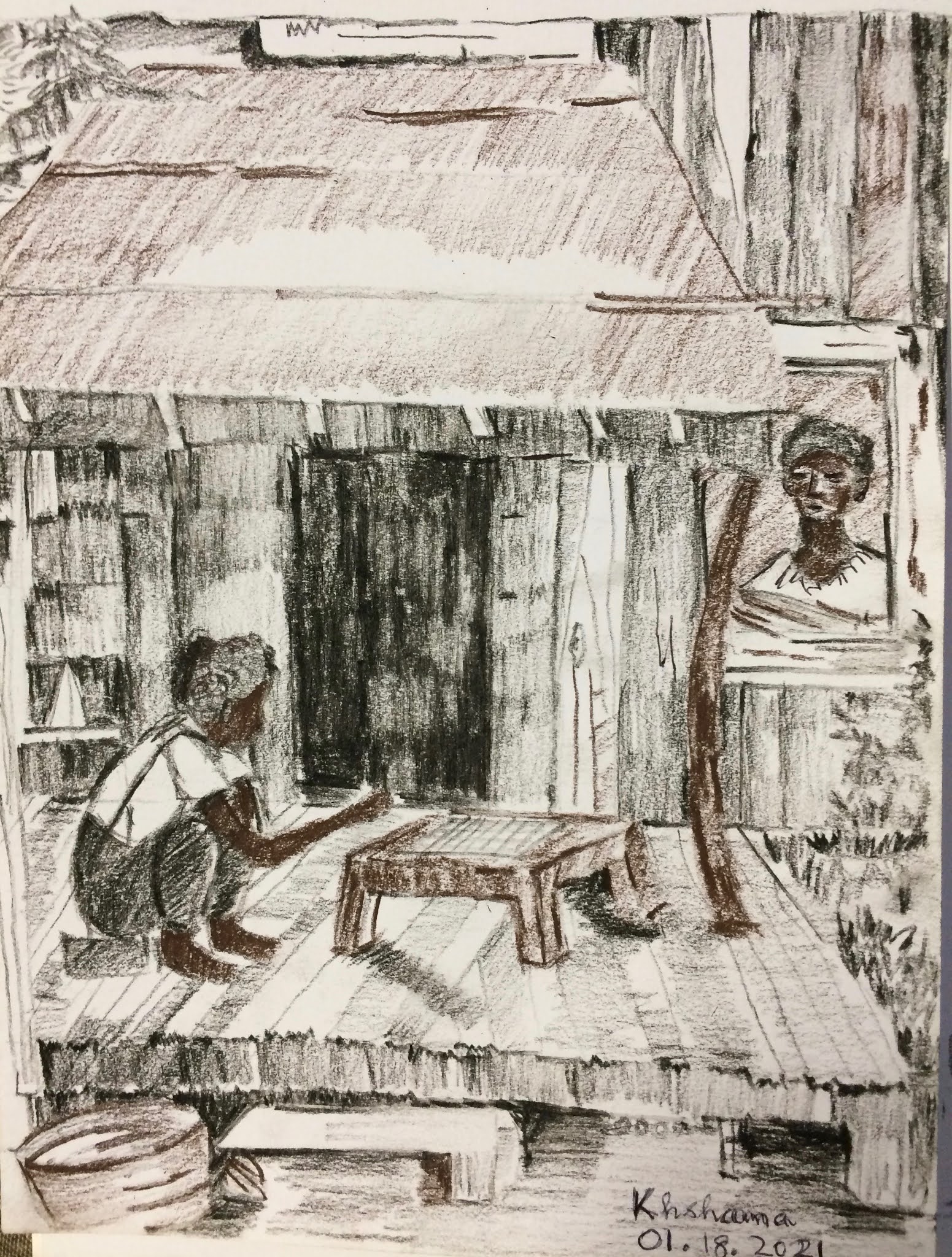
Original Illustration (Charcoal work) : A scene from Zora Neal Hurston's play "Woofing" 1931 set in Negro Street, Waycross, GA. 
All Rights Reserved, Haimonti Dutta, Jan 18th, 2021.

Here is an excerpt from the play
ACTION: Thru the open window of 'one' of the shacks a WOMAN is discovered ironing. A MAN is sitting on the floor of the porch asleep. She hums a bar or two, then comes to the window and calls to the man.

Woman: Good Black, why don't you git up from dere and carry dese white folks clothes home? You always want money but you wouldn't hit a lick at a snake! 
Man: Aw, shut up woman. I'm tired of hearin' bout dem white folks clothes. I don't keer if dey never git 'em. 
Woman: You better keer! Dese very clothes took and brought you out de crack. 'Cause de first time I saw you you was so hungry till you was walkin' lap-legged. Man, you had de white-mouf, you was so hungry.


Friday, January 25, 2019

Story Telling at Country Parkway Elementary School


Reading a story entitled "A Little World of Mud" from Ruskin Bond's Children's Omnibus -- showcasing the work of a great Indian author of British descent -- on the occasion of International Night at my son's school. Here's the first part of the recording for my friends who missed it.Video Courtesy: Agneya Dutta Pooleery


Tuesday, October 17, 2017

A short review: The Hungry Tide. Amitav Ghosh.

The Hungry Tide. Amitav Ghosh.

A very well researched book. Although the setting of the novel is in Lusibari and Garjontola, both fictitious places - the very depiction of tide country (Sundarban, WB) and details pertaining to the environment, the description of people living in the area and the constant fear they are subject to (primarily arising both from crocodiles and tigers) makes one realize that the author has spent a substantial part of his life studying and familiarizing himself with the area.

A mesmerizing paragraph from the novel:
"Then the noise of the storm deepened and another roar made itself heard over the rumbling din of the gale, a noise like that of a cascading waterfall. Stealing a glance through her fingers, Piya glimpsed at something that looked like a wall, hurtling toward them from downriver. It was as if a city block had suddenly begun to move: the river was like pavement lying at its feet, while its crest reared high above, dwarfing the tallest trees. It was a tidal wave sweeping in from the sea; everything in its path disappeared as it came thundering toward them. Piya's mind went blank as disbelief yeilded to recognition. Up to this time there had been no time for terror, no time to absorb the reality of the storm and to think about anything other than staying alive.But now it was if death had announced its approach and there was nothing to do but to wait for its arrival."

Yet another surprising fact is the issue of refugee rehabilitation and the research that went into it including references to articles found in Journal of Asian Studies, theses and unpublished manuscripts validating the historical treatment of the subject. Dolphins have also been studied in some detail and the author's note at the end of the book confirms his communication with world renowned cetologist Professor Helene Marsh of James Cook University.

The references to the writing of Rainer Maria Rilke are well worth yet another investigation -- particularly, for those like me, with little or no exposure to lyricism in German literature.

Friday, June 16, 2017

A Short Book Review: The Grass is Singing, Doris Lessing.

The Grass Is Singing. Doris Lessing.

A story set in southern Africa. Apartheid. Portrayal of what life becomes in a social system where apartheid rules.

I found it disturbing. Mary Turner's loneliness in poverty is gruesome.
"Time passes quickly, rushing upwards, as it does in those periods when the various crises develop and ripen in each life show like hills at the end of a journey, setting a boundary to an era. As there is no limit to the amount of sleep to which the human body can be made to accustom itself, she slept hours everyday, so as to hasten time, so as to swallow great gulps of it, waking always with the satisfactory knowledge that she was another few hours nearer deliverance. Indeed she was hardly awake at all, moving about what she did in a dream of hope, a hope that grew so strong as the weeks passed that she would wake in the morning with a sensation of release and excitement, as if something wonderful were going to happen that very day."

The writing is unparalleled. The triumph of the black servant--gory, savage and hideous in the face of insanity and loneliness faced by his white masters sends shudders down one's spine. He is not ignorant. His eye towards detail and ability to understand the need without being told, makes him powerful and fierce. But somewhere deep down that superiority needs to be contained, because apartheid rules. 

Friday, February 3, 2017

The metaphysical world of Anne Dillard.

An excerpt: 
Last year I saw three migrating Canada geese flying low over the frozen duck pond where I stood. I heard a heart-stopping blast of speed before I saw them there; I felt the flayed air slap at my face. They thundered across the pond, and back, and back again. I swear I have never seen such speed, such single-mindedness, such flailing of wings. They froze the duck pond as they flew; they rang the air; they disappeared. I think of this now, and my brain vibrates to the blurred bastinado of feathered bone. "Our God shall come" it says in a psalm for Advent, "and shall not keep silence; there shall go before him a consuming fire, and a mighty tempest shall be stirred up round about him." It is the shock I remember. Not only does something come if you wait, but it pours over you like a waterfall, like a tidal wave. You wait in all naturalness without expectation or hope, emptied, translucent, and that which comes rocks and topples you; it will shear, loose, launch, winnow and grind. 

I have gutted on richness and welcome hyssop. This distant silver November sky, these sere branches of trees, shed and bearing their pure and secret colors - this is the real world, not the world gilded and pearled. [...] I am buoyed by a calm and effortless longing, an angled pitch of the will, like the set of the wings of the monarch which climbed a hill by falling still.  
                                          - Anne Dillard, The Pilgrim at Tinker Creek.


Sunday, June 12, 2016

Review of The Old Man and the Sea, Ernest Hemingway


The Old Man and the Sea. Ernest Hemingway.

A story about the pursuit of resilience. An old fisherman has not been 'lucky' at sea. Without a catch for forty days, [and feeling desperate] he decides to take off on his skiff far away into the sea.
Alone. He grapples with loneliness.

"He looked around for the bird now because he would have liked him for company. The bird was gone. You did not stay long, the man thought."

Finally, there is a tug on the bait. Somewhere miles and miles beneath the surface a large fish may have eaten it. He does not know what kind of fish it is, how big it is or even whether he should wait for it. He decides to wait it out. A few days pass without food (except raw fish he catches from the sea such as dolphin and flying fish) and very little water. What follows is a relentless agonizing battle - observing the behavior of a fish, waiting in anticipation for it to tire out and then pull him on board. The soliloquy of the old man sweeps the reader away - for example, when he convinces himself that it is important to take rest, just as perhaps the fish down below needs some rest too.

"Rest now old man, and let him work until your next duty comes. [Pg 76]"

After the battle is won, he realizes the catch is too big for his skiff.
"Then his head started to become a little unclear and he thought, is he bringing me in or am I bringing him in? If I were towing him behind, there would be no question. Nor if the fish were in the skiff, with all dignity gone, there would be no question either. But they were sailing together [the huge marlin had to be fixed up on the side of the skiff] lashed side by side and the old man thought, let him bring me in if it pleases him. I am only better than him through trickery and he meant no harm."

The conclusion that the battle was but won through 'trickery', leaves the reader numb. The notion of what makes one person 'better' than another raises philosophical questions on morality, values and existence.

And the climax " 'But man is not made for defeat', he said. A man can be destroyed but not defeated."

===
Notes on why I found this book so appealing:

Hemingway has played a crucial role in the formative years of my life. The first book I read was from my school library at Loreto, Asansol. 'A Farewell To Arms'.
I remember reading 'For Whom the Bell Tolls' with my husband at our regular haunts to the 'Landmark' bookstore in Chennai. Along the way, I have read several other books, but 'The Old Man and the Sea' with its simplicity of language and diction leaves one mesmerized. I have probably read this earlier. With age, the appreciation for this Pulitzer prize winning novella has simple increased.

I wanted to re-read this work, ever since we happened to take a trip to West Palm Beach Florida. Not only did we wander on the beaches, play in the sand, pick up giant sea shells, watch turtles, and glorious sunrises - our resort faced the ocean, giving us an opportunity to listen to the music of the sea. The fishing trawlers would leave early in the morning and I was lucky to wake up early and watch them. One followed another as they headed deep into the sea. Eventually, the family decided to go fishing! And while we were not expert fishermen - it left an indelible impression on our minds - including the then three year old who got to see live 'sharks'.


Sunday, October 18, 2015

Review of 'Description of a struggle', Franz Kafka

My first reaction after reading the 'Description of a struggle' was one of complete resentment. I neither understood the plot, nor the hidden meaning the reader had to take home.

Haunted by this disturbing feeling, I decided to search for reviews of this novella. Quoting Wikipedia,"[the work] .. is often dismissed by critics turned off by its fragmentary nature and lack of polish. John Updike, in his foreword to an English language collection of Kafka's stories calls it (along with Wedding Preparations in the Country another early story) repellent containing something of adolescent posturing and advises new readers of Kafka to skip them. Updike encourages readers to return to these early stories once initiated with his other works."

While this was encouraging, it did not relieve me of the sense of discomfort. I re-read the story only to realize that the fact that the narrator never identifies himself was part of his style of writing. In other words, one never gets to know who the protagonist is, what he does, where he lives and so on which builds a surrealism that is sometimes hard to digest. 

How can you ride (like a horse) an acquaintance from a party? 
He says "I leapt onto the shoulders of my acquaintance and by digging my fists into his back I urged him to a trot." One suddenly realizes that he is not in the real world any more. 

The description of the fat man being carried by the litter was revolting. For example, "His folds of fat were so carefully spread out that although they covered the whole litter and even hung down his side like the hem of a yellowish carpet, they did not hamper him." The conversation with the supplicant is a scathing criticism of religion - a young man with an emaciated figure who throws himself on the ground and beats his skull in the palms of his hand on the stone floor - is a hypocrite who does what he chooses to because he gets attention. It almost feels like Kafka pities people with blind faith. Why are they believers - not because they strongly feel so from within, but because there are people watching their actions. 

In short, the narrator has an acquaintance-the acquaintance meets a girl he falls in love with. No one ever knows who is the narrator, acquaintance or the girl he loves. One only works with emotions-some questions that seem apt to ask at the moment, but perhaps rising out of incidents that occurred in the past. 

This being my first read, I take Wikipedia's advice to heart and will bravely read some of his other masterpieces before revisiting this novella again.